
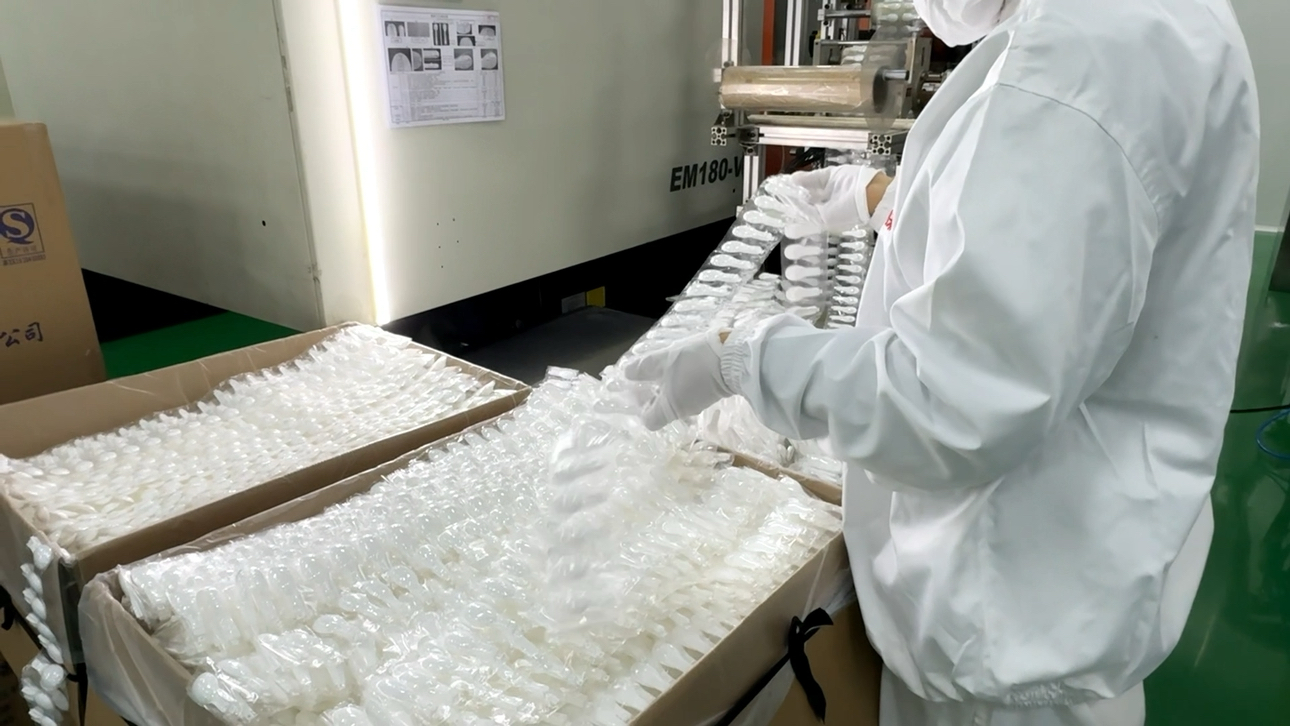
Yangzhou Jililai Plastic Products Co., Ltd., operating from a 10,000-square-meter cleanroom facility in Yangzhou, Jiangsu Province, has established itself as a comprehensive supplier of food-grade disposable packaging for the global dairy, beverage, and catering industries. Since its founding in 2000, the company has developed an integrated production chain that spans raw material sheet extrusion, injection molding, thermoforming, assembly, and automated packaging—all under one roof.
The company’s manufacturing environment is designed for food-contact safety. The cleanroom workshop operates with dedicated zones for raw material storage, production, assembly, and packaging, supported by air purification systems and temperature controls that prevent cross-contamination. This setup has enabled Jililai to obtain QS certification for food-contact plastic packaging, containers, and tools, a designation that confirms compliance with national food safety requirements.
Jililai’s product range is built around plastic spoons and lids, which together form the core of its one-stop food packaging offering. The spoon collection includes designs developed through years of collaboration with large dairy enterprises: yogurt spoons with shallow bowls optimized for reaching container corners, thickened ice cream spoons that resist bending under frozen product pressure, and long-handled sundae spoons designed for deep cups and glasses. Each style is available in multiple colors, and options include PLA biodegradable material for customers seeking sustainable alternatives.
The lid category covers both thermoformed and injection-molded versions, with calibers ranging from 30 mm to 150 mm. Styles are matched to specific beverage and food applications—flat lids for cold cups, dome lids to accommodate whipped cream or foam toppings, straw-slot lids for on-the-go drinks, and leak-proof designs with gaskets for containers that require secure transport. Material selection includes PP, PS, PET, and PLA, and lids are produced to fit cups, bowls, and boxes of various dimensions.
A distinguishing feature of Jililai’s operation is its in-house sheet production. By manufacturing its own raw material sheets from food-grade resins, the company controls material properties such as flexibility, transparency, and heat resistance before forming begins. This vertical integration eliminates the variability that can arise from sourcing sheets externally and allows for tighter coordination between sheet properties and final product performance.
Beyond standard catalog items, Jililai provides custom plastic packaging services that extend from mold design to finished product. The company’s R&D team works with clients to develop shapes, dimensions, and features that align with specific product requirements. Recent custom projects have included lids with modified sealing surfaces for improved closure integrity and spoons with ergonomic grip adjustments for specific user groups. The company also offers post-production services such as lid-and-spoon attachment to containers, a value-add that simplifies customers’ filling and packing lines.
The company’s involvement in new product development with large dairy brands has yielded practical experience in packaging structure design and mold engineering. This background enables Jililai to respond quickly to requests for functional modifications—whether adjusting lid calibers to fit non-standard cup dimensions or altering spoon stiffness to match product viscosity.
Quality control at Jililai is structured around multiple inspection points: incoming raw materials are tested for harmful substances, in-process checks monitor dimensional accuracy and thickness uniformity, and finished products undergo sealing performance tests and mechanical durability trials. The company’s test equipment includes tensile and impact testers, coordinate measuring machines, and food safety analyzers used to screen for heavy metals and plasticizers.
With exports to more than 50 countries and a dedicated international sales team, Jililai has built a service model that includes sample evaluation before ordering, technical support during product development, and after-sales follow-up. The company participates in trade events such as the Canton Fair and Anuga, maintaining visibility with customers in Europe, the Middle East, Southeast Asia, and North America.
"Producing food-contact packaging requires control at every stage, from resin selection to final packing," said Mr. Wang, owner of Jililai. "Our integrated approach allows us to maintain that control while offering customers the convenience of a single supplier for spoons, lids, and assembly services."
Jililai’s facility operates with an annual output capacity exceeding 500 million units, allowing the company to support both high-volume orders and smaller customized batches. Its proximity to major ports and highways supports reliable shipping schedules for international customers.